

by KS
The Communist Manifesto was first published in the English language around 1850 for a Chartist newspaper based in London named The Red Republican. Pioneering feminist Helen Macfarlane did the translation. It wasn't published in the USA until a dozen years later, in Woodhull and Claflin's Weekly. All of these periodicals were short-lived, despite the enduring relevance of Karl Marx and Fredrich Engels' Q&A pamphlet.
The Political Education Committee of the San Antonio chapter of DSA set about reading the manifesto aloud on Thursdays starting in September of last year and finishing up in early December. Book clubbers called out the Manifesto's bygone references to pre-industrialized nations as "barbarian" and discussed the looming threat of mass unemployment supposedly posed by Artificial Intelligence. Clearly we're still witnessing and living with the consequences of the "blind destruction" which Marx and Engels saw as wreaking havoc on societies in the warpath of profit-maximization.
When Marx and Engels predicted that the universal suffrage movement in Germany would serve as "the prelude to an immediately following proletarian revolution," I couldn't help but interject: "Spoiler alert: that didn't happen!", which got a few laughs. Hope springs eternal, however. What follows is based on some notes I took during those meetups.
In the preamble, the authors ask rhetorically: "Where is the party in opposition that has not been decried as 'communistic' by its opponents in power?"
This still rings true. No pejorative labels get tossed around more loosely and interchangeably in modern political discourse than 'communist', 'Marxist', and 'socialist'. Leaders of the Republican Party - now in control of the presidency, both chambers of Congress, the Supreme Court, and a majority of state governorships - persistently associate their rivals in the Democratic Party with communism, over the objections of card-carrying members of Communist Party USA.
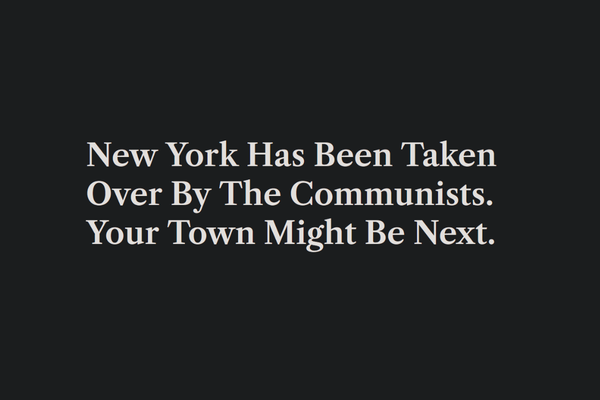
"New York Has Been Taken Over By The Communists," the extremist right-wing website Daily Wire proclaimed in June, "And Your Town Might Be Next." This headline, reminiscent of 'Invasion Of The Body Snatchers' and coming with a cover image oozing with AI generated gloss, ran after a slate of candidates backed by the mayor of New York City, Zohran Mamdani, won in Democratic primaries. None of the winners self-identified as communists, but two of the three held endorsements from the Democratic Socialists of America. (Texas oil and gas billionaires Dan and Farris Wilks, by the way, gave millions of dollars in seed funding to start The Daily Wire in 2015, though the propaganda outlet has recently fallen on hardtimes.)
In his speech at Mount Rushmore to commemorate the 250th anniversary of the Declaration of Independence, President Donald Trump spoke of "a resurgence of the communist menace in our land" as "the greatest threat to our country, including World War I, World War II, Pearl Harbor, or even 9/11." Even for a sleazy salesman with a well-documented penchant for exaggeration, that takes the cake.
Back in February 1848, Marx and Engels drew two conclusions from the pervasiveness of 'communist' as a popular rebuke.
First, they reasoned: "Communism is already acknowledged by all European powers to be itself a power."
Second: "It is high time that Communists should openly, in the face of the whole world, publish their views, their aims, and meet this nursery tale of the Spectre of Communism with a manifesto of the party itself."
The first statement is a fallacy, and I suspect Marx may've meant it a bit tongue in cheek. You cannot infer from self-serving partisan rhetoric to a genuine assessment of any group’s actual political impact. Red-baiters may stuff scarecrows of the Red Menacewithout believing a word of it. Trump, for instance, repeatedly called then-candidate Mamdani "a communist", only to invite him to the Oval Office after his historic victory - paying him nothing but compliments, and proving the age-old adage "game recognizes game".
The second statement is what's crucial. Marx's brand of socialism, or communism, is a *majoritarian* project with a *transparent* policy platform; it's not some secret organization attempting to seize power then impose utopia from on high behind everybody's backs. That's why the Communist League - formerly the League of the Just - commissioned Marx and Engels to write a manifesto in the first place. The pamphleteers' explicitly-stated goal was "to win the battle of democracy" in countries where enough workers had the vote. Either the proposed changes would be grounded in a broad democratic coalition, or else they would not genuinely represent self-emancipation. This is the unabashedly pro-proletarian line Marx and Engels sought to distinguish from all the other currents of socialism on offer in their day. Robert Owen, for example, advocated withdrawing into communes, and anarcho-socialists like Mikhail Bakunin insisted on violent coups to seize, and then disband, the state.
"Marx and Engels never showed any sympathy for those radicals who used violence in democratic countries," wrote Richard Hunt in his magisterial two-volume work, 'The Political Ideas of Marx and Engels' (sadly, out of print). Although neither condemned the assassination attempts on "Czar Alexander II in tyrannical Russia", Hunt explained, "Engels excoriated those Irish terrorists 'who produce pointless schoolboy parodies of the anti-czarist struggle in Western Europe'." In 1886, when the Social Democratic Federation of London turned a peaceful assembly into a violent demonstration, Engels declared that the smashing windows, rioting, and looting "have done irreparable damage to the movement". Although militant self-defense and civil disobedience have been hallmarks of all forms of leftist agitation, past and present, surely some of the hijinks carried out under the banner of Antifa would qualify as "pointless schoolboy parodies" in Engels' meaning above. Hunt summed up:
"One will search the writings of Marx and Engels in vain to find any advocacy, either specific or in general, of the use of political violence as an offensive weapon in stable democratic countries. Even in Germany, during the years when the Social Democratic party was illegal, the two men opposed any deliberate violent initiative, while at the same time encouraging all sorts of illegal nonviolent activities - underground organizing, printing and distributing of illegal literature, and so forth."
Fast forward to the 21st century and criminal prosecution for merely distributing literature is not an outlandish hypothetical. This June, Daniel Sanchez Estrada, a Texas tattoo artist, was just sentenced to 30 years in federal prison for moving a box of left-wing zines, which prosecutors cited as evidence of his involvement in a terrorist conspiracy. Estrada was not even present at the anti-ICE protest that resulted in the indictments. "It all sounds preposterous," reported The Intercept, "but virtually nothing is too absurd for this Department of Justice."
Juxtaposed with lawlessness like that, the recommendations of the manifesto, sketching out the first steps for a rational and humane transition to socialism, must qualify as tame. As comrade Slavoj Žižek once noted, most of the ten policy measures suggested as a guideline at the end of chapter 2 have by now been implemented in liberal capitalist countries. True, some 90 years had to pass before the US federal government finally got around to banning child labor in 1938, but:
a progressive income tax,
a post office,
a central bank,
national parks,
toxic waste cleanup,
farm subsidies,
the use of eminent domain to build out infrastructure,
rural development projects,
state-owned enterprises,
and universal public education
- all these are staples of modern society, although Big Business fought many of these reforms tooth and nail. The proverbial ‘abolition of private property’ may sound extreme to neoliberal ears, until one draws an obvious distinction between one’s personal belongings and the corporate privatization of what ought to belong to the people as a whole anyway. Communists aren't after anyone’s Steely Dan records, whereas nationalization of fossil fuel reserves - as Norway did in the 1970s - is vitally important to addressing the climate emergency. "These measures will, of course, be different in different countries," Marx and Engels stipulated. Perhaps doing away with all inherited wealth is a bridge too far for the US electorate, for example. But surely we could increase the estate tax, which currently applies to only 0.2% of taxpayers. The Waltons of Walmart-fame are the richest family on the planet with a combined net worth of over $500 billion. Couldn't we use that money to pay the tuition for every high school graduate who wants to go to college? What’s so ‘radical’ about that?
There are places where the age of Marx's text undoubtedly starts to show. "The proletarian is without property; his relation to his wife and children has no longer anything in common with the bourgeois family relations; modern industry labour, modern subjection to capital, the same in England as in France, in America as in Germany, has stripped him of every trace of national character. Law, morality, religion, are to him so many bourgeois prejudices, behind which lurk in ambush just as many bourgeois interests."
Today, two out of every three US adults are homeowners, a demographic Trump won by a significant margin. Even the lowest-paid workers might own their own car and smartphone and are liable to feel emotional when hearing the national anthem before a ballgame. So a ‘property-less, nation-less’ proletariat was simply not in the cards for us. Historically, the loss of shared land to royal and private expropriation - so-called ‘enclosure of the commons’ - served to radicalize European agrarians and artisans, while the American experience of landless immigrants being gifted free homesteads in the States had much the opposite effect. Even at the height of the Great Depression, the worst crisis of capitalism to date, estimates are that 2 million people in the US were homeless, out of a country of 125 million. With all due respect to Marx and Engels, most of us who are not independently wealthy have still got a lot more to lose than just our chains.
That's not to say we should take the unnerving precariousness of living under capitalism lying down. Market forces are not forces of God or Nature. To quote at length from labor sociologist Charles Umney's wonderful 2018 summaryof Marxian class analysis:
"We might agree it's a shame that many train guards are being laid-off, but accept it as inevitable due to advances in ticket machine technology. Supply has come to outweigh demand, and so there must be an inevitable adjustment to these market conditions. In this kind of argument, supply and demand are spoken about as natural 'laws' to which humans must adapt, in the same way as we must learn to cope with the law of gravity, or our inability to breathe under water. But this is not how Marx sees it. ...
The balance between supply and demand is, in some key respects, regulated directly by capital. By seeking to grow, capital expands the demand for labour, but by investing in labour-saving technology or by laying people off for whatever other reason, it can also decrease this demand. Capitalists can choose whether to invest in technology that directly replaces workers without improving 'customer service' (such as ticket machines), or invest in technology that improves service without necessarily making people redundant (such as expanding or improving train capacity). So it is nonsense to talk about the supply and demand for labour as if they were neutral laws of economic gravity. ‘Les dés sont pipés’. (The dice are loaded). Capital acts on both sides at once'. ...
If there was no unemployment and poverty, labour would be less scared to demand higher wages and reduced working time, and so would become insufferably overconfident from capital's perspective."
So deprivation motivates effort, as we learned during the pandemic when employers griped about how ‘workers didn't want to work anymore’ thanks to unemployment and stimulus payments. As real estate mogul Timothy Gunter expoundedin 2023:
"We need to see unemployment rise. Unemployment needs to jump 40-50%, in my view. We need to see pain in the economy. We need to remind people that they work for the employer, not the other way around. There's been a systematic change where employees feel the employer is extremely lucky to have them... it's a dynamic that has to change. We've got to kill that attitude".
He later apologized, but no doubt was speaking for many capitalistswhen he said what he said.
"It has been objected that upon the abolition of private property, all work will cease, and universal laziness will overtake us," the manifesto sets up a common objection to socialism. "According to this, bourgeois society ought long ago to have gone to the dogs through sheer idleness; for those of its members who work, acquire nothing, and those who acquire anything do not work."
I know I'd pay good money to watch a billionaire CEO try to make it as a nurse, or a firefighter, or a roofer, or a school teacher. But it's worth appreciating how much all of us, rich and poor alike, participate in a recklessly destructive system.
"When your favorite independent bookstore closes down in the face of competition from discount and Internet booksellers, you might moan about how good it was for your town to have such a place, and how unfortunate it is that the shop was not a profitable venture anymore," political scientist William Clare Roberts wrote in his 2017 insta-classicon volume one of Marx's 'Capital'. "And yet you might also have done much of your own book buying on the Internet," he added.
"In a similar vein, a family member recently posted the following rant on Facebook:
'You know how the Ben Davis label used to say 'union made, plenty tough'? Then it said 'USA made, plenty tough'. Looking at my jacket, I realized now it just said 'Plenty tough' and was made in China! I am pissed off now'.
There is no reason to think that the owners of Ben Davis are not also upset that they can no longer stand by their old commitments. On a larger scale, there has been some reporting to the effect that certain oil company executives think hydraulic fracturing is a dangerous and unsustainable practice, but that it must be pursued regardless because it is the only economically viable avenue for exploiting the remaining petroleum reserves.
In each of these cases, something - buying books from the local bookstore, having a unionized and local workforce, refraining from fracking - is not done, not because the agents involved don't think it is worth doing, but because they feel compelled to bow to economic imperatives."
That's how we end up with an economy that we serve instead of an economy that serves us.
For a literary analogy, consider Goethe's ballad of The Sorcerer's Apprentice, retold by Walt Disney in the 1940 animated feature 'Fantasia'. Much like the novice stealing his master's magic hat to avoid doing chores, wealthy liberal elites - the ‘bourgeoisie’ in Marx’s language - took over the reins of society from feudal lords, yet were "unfit to rule" and unleashed great technological forces they could neither anticipate nor control. "Spirits that I've cited / My commands ignore," screams the apprentice, as hordes of enchanted broomsticks, dumping endless pails of water, begin to flood the place. Unlike Goethe's story, however, no Gandalf-like wizard is coming to our rescue.
The role of the enchanted broomsticks could be played today by Artificial Intelligence. Marx and Engels' gamble was that the unintended consequences of capitalist progress itself might save us.
The manifesto: "In place of the old wants, satisfied by the production of the country, we find new wants, requiring for their satisfaction the products of distant lands and climes."
So we start to expect more from life than we did before - coffee from Brazil, shoes from Italy, electronics from Japan.
"The cheap prices of commodities are the heavy artillery with which it batters down all Chinese walls, with which it forces the barbarians' intensely obstinate hatred of foreigners to capitulate."
So provincialism and xenophobia lose out to cosmopolitanism and free trade.
"The feudal relations of property became no longer compatible with the already developed productive forces; they became so many fetters. They had to be burst asunder; they were burst asunder."
So innovation puts feudalism out to pasture and blazes a secularizing path forward. Ostentatious displays of luxury, common in the age of monarchs, become less important than re-investing profits back into the business, expanding industrial-scale production and ensuring a vast surplus of goods.
Suppressing wages leads to unionization and worker solidarity. And so on.
Of course, this story's not remotely rosy. Quality craftsmanship suffers due to assembly-line manufacturing; work becomes routinized and militarized in office spaces and factories alike; people start to feel treated like replaceable, disposable cogs in an impersonal machine.
And much like the Make America Great Again movement, this alienation can trigger a romanticized nostalgia for the supposed stability of the past. "The lower middle class, the small manufacturer, the shopkeeper, the artisan, the peasant: all these fight against the bourgeoisie, to save from extinction their existence as fractions of the middle class," Marx wrote. "They are therefore not revolutionary, but conservative. Nay more, they are reactionary, for they try to roll back the wheel of history."
This is what authoritarian right-wing populists, both here and abroad, are busy trying to do - to roll back the wheel of history. Yet to quote Benjamin Franklin, "He who spits in the wind, spits in his own face".
In chapter 3 of the manifesto, Marx and Engels pertinently distinguish various brands of anti-capitalism from their own: (a) feudal socialism, (b) petty bourgeois socialism, (c) German socialism/universal humanism. Today we have *rural anti-capitalism* that distrusts large financial institutions, and can too easily slip down the rabbit hole of antisemitic conspiracism about how ‘the Jews’ ‘run the world’; we have *small business anti-capitalism* that blames so-called ‘crony capitalism’, as if monopoly and corporate lobbying weren’t baked into the system; and we have *academic anti-capitalism* that speaks loftily about humanity and can devolve into in-groupjargon. Marx's humanism is far more minimalist. Whatever grand theories we may entertain about ‘human nature’ - whether innately benevolent, cooperative, selfish, or aggressive - we can nevertheless insist that people should be able to talk and deliberate among themselves and decide issues of shared concern together. That's the prudent and practical alternative to the ‘blind destruction’ of market-dominated globalism.
Even if that alternative sounds unachievable in our lifetime, and insurrectionary calls for the (badly misinterpreted) ‘dictatorship of the proletariat’ seem bygone today, the immutable style of the manifesto remains vital for citizens of aspiring democracies to continue to embody:
(1) begin with what workers are going through and what their specific demands are;
(2) refrain from condescending moral preachments and don't sugarcoat anything;
(3) ruthlessly debunk all those who try to limit future horizons by citing some highfalutin economic theory;
(4) investigate in a hard-nosed manner the system's turbulent regularities, its everyday abuses, not just the dramatic booms and busts;
(5) keep a sense of humor and irony, and let that communicate moral outrage and compassion, while your mind stays uncloudy and unsentimental.
'Heart on fire, mind on ice', the saying goes.